 Hack the Hydra
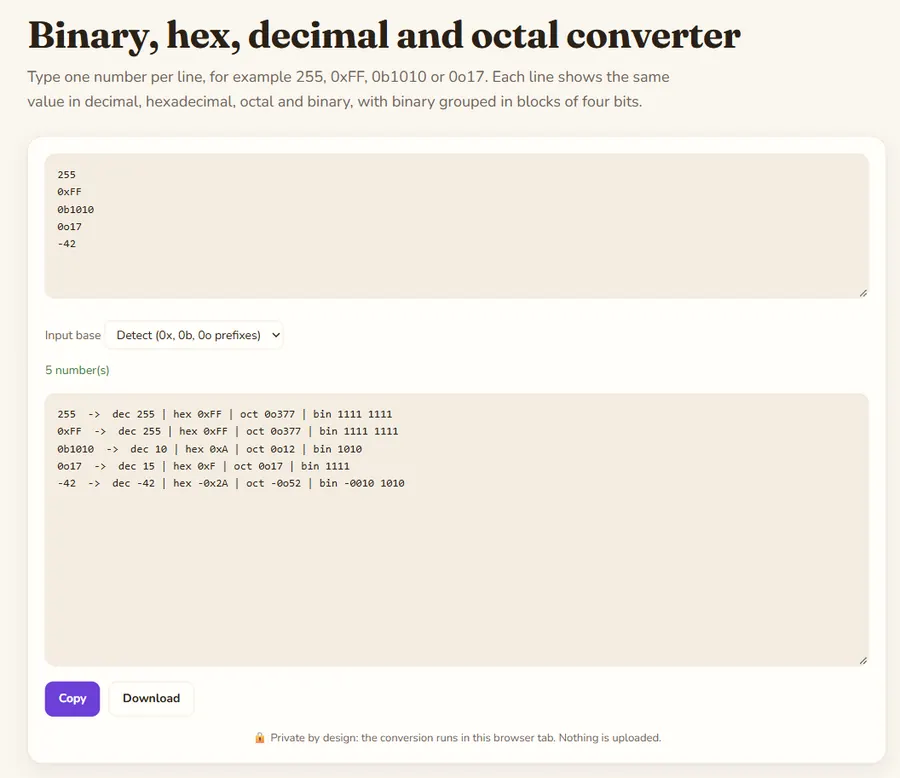
How the input base is detected
With "Detect", 0x means hexadecimal, 0b binary and 0o octal. A number made only of digits 0-9 is read as decimal, and one containing the letters a-f (such as ff) as hexadecimal. If a value like 1010 is meant as binary, choose "Binary" as the input base instead of relying on detection.
Exact for any size
The conversion uses arbitrary-precision integers, so 64-bit values such as 18446744073709551615 (0xFFFFFFFFFFFFFFFF) stay exact, unlike many calculators that round above 2^53. Underscores and spaces inside a number are ignored, so 1111_0000 and FF FF are accepted.
Negative numbers
A minus sign is kept in front of every result, for example -42 is -0x2A. This is the signed value, not the two's complement bit pattern a CPU would store; for a 32-bit two's complement of a negative number, add 2^32 (4294967296) first.
Example
Three numbers written in different bases, detected from their prefix.
Input
255
0xFF
0b1010
Output
255  ->  dec 255 | hex 0xFF | oct 0o377 | bin 1111 1111
0xFF  ->  dec 255 | hex 0xFF | oct 0o377 | bin 1111 1111
0b1010  ->  dec 10 | hex 0xA | oct 0o12 | bin 1010