 Hack the Hydra
How to calculate percentage increase and decrease
Percentage change = (new - old) / old x 100. A result above zero is an increase and below zero a decrease. To take X% of a number, multiply it by X / 100. To apply a discount of X%, multiply the price by (1 - X/100).
How do you calculate a percentage change?
Subtract the old value from the new one, divide by the old value and multiply by 100. A price that goes from 80 to 100 changed by (100 - 80) / 80 x 100 = +25%. A price that goes from 100 to 80 changed by (80 - 100) / 100 x 100 = -20%. The same 20 euro gap gives different percentages because each is measured against its own starting value.
How do you find X% of a number?
Multiply by X and divide by 100: 15% of 200 is 200 x 15 / 100 = 30. To find what percentage one number is of another, divide and multiply by 100: 30 out of 200 is 30 / 200 x 100 = 15%.
Discounts and sales tax
A 20% discount on 80 leaves 80 x 0.8 = 64. Adding 21% VAT to a net price of 150 gives 150 x 1.21 = 181.50. Going back from gross to net means dividing by 1.21, not subtracting 21%, because 21% of the gross amount is more than 21% of the net amount.
What are the common mistakes?
- Averaging percentages: a 10% rise followed by a 10% fall does not return to the start; it ends at 99% of it (1.1 x 0.9).
- Mixing points and percent: a rate that moves from 4% to 5% rose by 1 percentage point, which is a 25% relative increase.
- Wrong base: always divide by the starting value, not the end value.
Do many at once
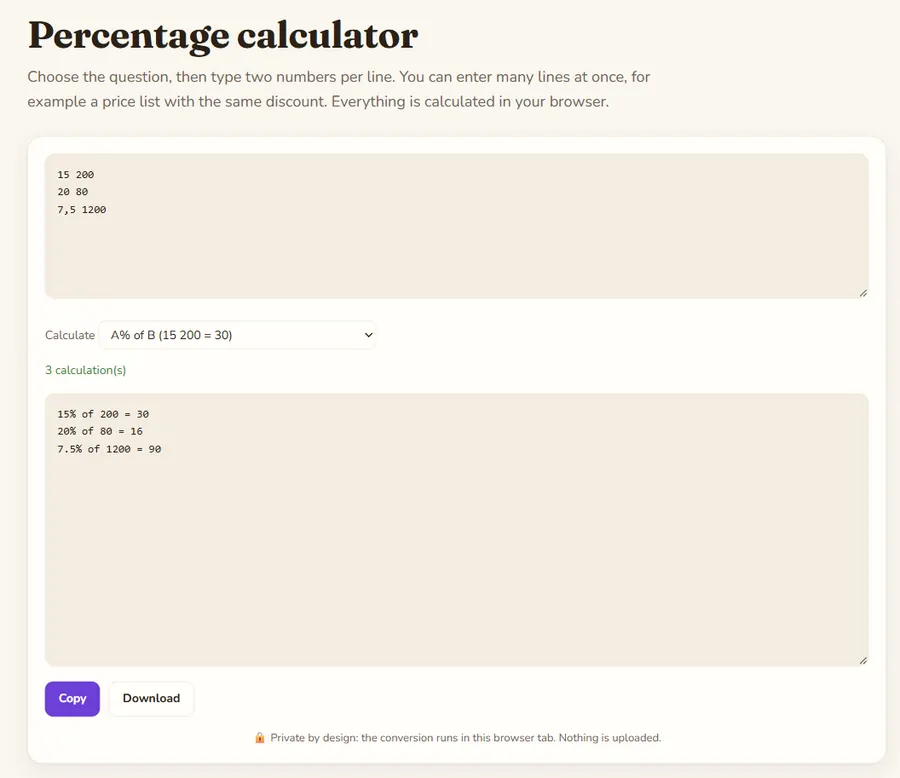
Open the percentage calculator, pick the formula, and type one pair of numbers per line to get a whole price list in one go. It runs in your browser.
All the formulas in one table
| Question | Formula | Example |
|---|---|---|
| By how much did it change? | (new - old) / old x 100 | 50 to 65: +30% |
| What is X% of Y? | Y x X / 100 | 12% of 250 = 30 |
| X is what percent of Y? | X / Y x 100 | 45 of 60 = 75% |
| Add X% to Y | Y x (1 + X/100) | 200 + 8% = 216 |
| Take X% off Y | Y x (1 - X/100) | 200 - 15% = 170 |
| Value before an X% increase | new / (1 + X/100) | 216 after +8% was 200 |
| Value before an X% discount | new / (1 - X/100) | 170 after -15% was 200 |
Worked example: a salary raise and a price rise
Your monthly salary goes from 2,400 to 2,520. The change is (2,520 - 2,400) / 2,400 x 100 = +5%. In the same year your rent goes from 800 to 860, which is (860 - 800) / 800 x 100 = +7.5%.
The raise is 120 a month and the rent rise is 60, so in money you are 60 better off. But rent now takes 860 / 2,520 = 34.1% of your salary, against 800 / 2,400 = 33.3% before: as a share of income, housing got slightly more expensive. Both statements are true; which one matters depends on the question you are asking. That is why a percentage should always come with its base.
What is the difference between percentage change and percentage difference?
Percentage change has a direction: there is an old value and a new value, and you divide by the old one. When two values have no before and after, for example the price of the same product in two shops (40 and 50), people often use the percentage difference: the gap divided by the average of the two, |40 - 50| / 45 x 100 = 22.2%. Saying "shop B is 25% more expensive than shop A" (10 / 40) and "shop A is 20% cheaper than shop B" (10 / 50) are also both correct; just say which shop you used as the base.
What happens with repeated changes?
Percentages multiply, they do not add. Three yearly rises of 10% give 1.1 x 1.1 x 1.1 = 1.331, so +33.1%, not +30%. To find the average yearly rate behind a total change, take the root: a value that doubled in 5 years grew by 21/5 - 1 = 14.9% a year on average, not 20%.
FAQ
How do I calculate a percentage increase between two numbers?
Subtract the old number from the new one, divide by the old number and multiply by 100.
How do I reverse a percentage increase?
Divide the new value by (1 + increase/100). For +25% from 100 to 125, 125 / 1.25 = 100.
Is a 50% increase followed by a 50% decrease the same as zero?
No. 100 becomes 150, then 75, so you end 25% below the start.
How do I find the original price before a discount?
Divide the sale price by (1 - discount/100). A price of 170 after 15% off was 170 / 0.85 = 200.
Last updated: November 2026. Facts about third-party tools come from their public repositories and documentation. Check licenses before commercial use.